Economic Analysis on Gacha Game Pricing - Part 2 - Innovation, Supply, and Demand
Written by Researcher Alex and Edited by Rei Caldombra 11/24/25 Previous Part: Economic Analysis on Gacha Game Pricing - Part 1 - General History — Blog Under a Log
In this article segment, I will explain how and why video game companies choose optimal video game monetization strategies from an economic viewpoint. I will first describe their concept of innovation. Specifically the difference between new innovation and modified innovation. This will then lead to a discussion on video games being centered as digital products. Since video games embody ideas like fantasy, exciting concepts, and/or ideal worlds that a consumer desires, it is important to see if these video game ideas are perceived in a large and accessible digital market. Are these ideas unique or competitive substitutes to each other? To answer this question, I look at how businesses and consumers value and price the idea represented in a video game. Then I observe why video game companies would choose to sell their game for a price of $0 as an optimal business strategy.
Sources are listed at the bottom of the article.
Video Game Innovation
Video game companies will conduct research to find ideas to gain money out of a consumer. Whether developing new products or new game modes that interests a consumer, companies must invest time and money to find something that would work. Once something works, companies can then build upon it into a monetization model. This process is called innovation.
What are the properties of innovation? An economic viewpoint
New genres, game modes, monetization strategies, and hardware are the forefront of keeping audiences engaged with the game and experience. However, innovation arises from researching newer experiences which takes time and resources to complete. Easy and cheap ideas in line with simple experiences and hardware are consumed quickly. People are able to afford the Gameboy Advance SP $99.95 in 2003 ($133.39 in 2017) vs a Nintendo Switch for $299.99 in 2017.
To play more games and to experience new ideas, new systems like gaming consoles like a PS5, the Wii, and the Xbox One are created to handle games that have higher graphics, haptic technologies like a Wii remote, customizable controllers with buttons, and VR systems. Computers that are used or upgraded for gaming can get a wider variety of games with downloads, browser sites, or online libraries like Steam. It would be assumed that games developed with more expensive hardware, more detailed graphics, or longer gameplay experiences would increase development costs and consumer costs in general. However, easier distribution through online or digital storefronts increases supply of copies to effectively infinite. Interestingly, the digital supply can be fixed to the exact demand because digital copies are not physical mediums. Which cannot be physically overstocked or understocked.
In short, it is hard to have two physical copies of the same game to sell if there are no physical copies to sell (because all copies are digital). Online keys can be given and taken with little to no cost to consumers. This means that demand for a game is a primary factor for a seller to consider. If a digital game is presented to a wide audience with minimal distribution costs like simply displaying advertisements on a storefront or social media account, then the amount of potential customers to buy the game will increase. More viewers would increase demand proportionally from a probability standpoint. For instance, if 1 out of 10 people would like to buy a game after 10 people view it, which is 10% of the total population, then exposing the game to a digital storefront that has 1000 people would likely have 100 people who are willing to buy the game after viewing it.
This shows that video games are primarily a consumer demand market with more people who know the game leading to more people potentially buying the game, which is why marketing is important for selling a video game. In short, marketing is an important point for a video game company that wants to make a profit or break even in development costs.
How consumer demand is the key target of innovation for a video game company
Game companies recuperate development costs by splitting out the cost across consumers. For instance, if a game costs $100 to develop, then selling a game for $10 would require 10 people to buy the game to break even. This is why games like Minecraft Java for PC which costs $29.99 in 2024 and only $26.95 in 2011 (for any ability to play on a PC) can primarily remain at this price because of a large audience for people to play with the company selling 30 million and above this amount in total copies of Minecraft PC in 2019.
Although this concept does not include updates, inflation, or studio costs, prices in this example have remained relatively stable over 13 years with about 0.87% price (rounded) increase per year [((29.99/26.95)-1)/13=0.00867704] which is well under 1%+ U.S. inflation rate. In short, the value of this game decreases every year because its price is not adjusted to the yearly inflation value of money.
Money is worth less every year which requires more money to pay for a single product. For instance, in a hypothetical scenario where 1 box is equal to 1 dollar in 2017 and if yearly inflation is 5%, then 1 box will cost $1.05 in 2018. If my box was priced at $1 in 2018, then I would lose 5 cents or about 4.76% of the value of my box. Since U.S. inflation in U.S. cities (this is the closest understandable metric to whole U.S. inflation I could find) is usually above 1% yearly on average except in 2015 and 2009, it is likely that the game in this example is losing money per sale almost every year due to inflation which makes no economical sense.
Interestingly, this fixed price goes against the upward trend of adjusting for inflation costs to maintain value for a game. This indicates that the initial cost of production for this game is highly likely covered by the large consumer base that only needs to pay a fraction of the cost.
But what happens when a video game company cannot cover their costs for a game? In a different scenario, if a game does not have any demand, then players need to cover a high-cost margin. The released game of Concord on both PS5 and PC in 2024 was priced at $39.99 but had little demand of an approximated total of 25,000 (15,000 for the PS5 and 10,000 for PC) units to cover the $400 million production cost which shut down in the same year (two weeks). Even if it was live service, the short life cycle of two weeks and abrupt closure of the game can be simulated as an initial release in comparison to a game like Minecraft.
Observing the economic costs and pricing in this scenario, it shows that even a moderately high game price with proportionally little demand in comparison to the initial production costs would not be enough to support the initial costs of a game. Even adjusted for persistent costs like live-service maintenance or updates from the studio, the present existence of Minecraft in 2011 to 2024 bearing these costs and not failing shows the financial strength of this game from its overall demand from its consumer base in comparison to the closure of Concord with the high initial development costs and low consumer base demand. The lack of a large price change also signifies that the franchise is able to recuperate initial development costs and have the overhead to maintain the studio in the long run. The 2019 release of the game Control was developed with a budget of 30 million Euros, sold 2 million units and beyond this amount in regard to sales in 2020, with a regular price of 59.99 US dollars on release or (47.60 Euros on release). Current stable price for standard edition is 29.99 dollars in 2024 on PlayStation Store and Xbox and PC (Epic store), while the overall price would be 23.86 Euros in 2019 for this stable price on all 3 platforms.
Unstable sources for money conversion and current official prices (reason: market fluctuations)
Even with a reduced sale price over time, the total sales amount of 47.72 million Euros with a decreased price of 23.86 Euros multiplied by a guaranteed 2 million units sold would well cover the development costs of 30 million Euros. In this context, consumer demand is the main driving factor out of all of these examples rather than supply. Conversion rates are at the end of the article.
Different levels of consumer demand require different levels of innovation
Although finding new ideas is a key component of innovation for video game companies, video game companies usually build upon other successful game concepts to reduce the cost of innovation. Running out of ideas to 100% innovate cheaply is more expensive and time consuming for research into new video game experiences. Building on a successful 70% game concept that is in high demand by consumers and adding 30% of a new idea or twist to a new video game is a cheaper option by 70%. This can be said as a form of modified innovation used by video game companies to reduce costs in research and development. Historically, as more new games are developed and experiences are exhausted, similar games are developed as a copy to the original game. Genres of games such as FPS, Platformers, MOBA, MMOs, JRPGs, Extraction Shooters, and Battle Royale all usually originate from a key game. For instance, Minecraft Hunger Games is inspired by Hunger Games. Maze War was one of the first FPS games created in the 1970-1980 era. Donkey Kong was the first platformer in 1981. After their release, a multitude of games such as DOOM, Mario, and PUBG all reach commercial success. However, more derivatives appear such as Fortnite: Battle Royale, Banjo-Kazooie, Mario game series, COD: Warzone, and Apex Legends. Sometimes, genres can also spawn new genres like the battle royale games using open world systems of PVP evolved into extraction shooter games like PVPVE which included games like Division 1, Escape from Tarkov, COD Warzone 2.0 DMZ, and The Cycle: Frontier that all had similar game mechanics to the battle royale concept. As different games reiterate and modify other games, the similarities per each game increasingly make each game an economic substitute good. This causes demand to become elastic. Since supply is tied to quantity demanded, it can be said that a large customer demand base and a multitude of similar games (like on an online market platform) would make prices stable but also infinitely makes games cheaper. This would explain why indie or mid-small games that are similar in nature may have lower or almost nonexistent costs (Free-$0.49-$4.99-$3.99-$9.99 games) on a large marketplace like Steam where there are lots of customers but similar genres. Vampire Survivors genre games on steam are priced cheaply like Nimrods: Guncraft Survivor at 8.49, The Nightwatch at $4.49, HSS:Reload at $6.92, The Spell Brigade at $7.99, and HoloCure – Save the Fans! at $0.00 (Free). *Based on 12/19/2024 Steam prices.
In short, if there are a variety of games with similar ideas in them, then a consumer can choose any of these games and still get a similar identical experience out of all of the games. This forces video games to innovate to be unique yet not become too unique to prevent research and innovation from becoming too expensive for the video game company. This form of modified innovation is a balance for video game companies to follow and an economical limitation against consumers from receiving unique games specifically by video game companies.
The Economic Concept Affecting Consumer Demand
So how does this balance of modified innovation affect consumer demand? Well, using the concept of elasticity from economics, we can simply ask the question of how many people will buy a video game that has an idea that they like and at what price will they buy this video game. In more complex terms, the price of modified innovation is dependent on the demand of the consumer who wants the idea, concept, or experience materialized into an intractable medium.
In a normal physical retail market, a simple supply and demand graph would suffice to show how many copies of a game a person would buy from a retail store to get an accurate price amount for a particular concept. This widely applied method can be applied to other markets such as fashion, art, and food. However, since the digitalization of products has made certain ideas or products like video games nonphysical, the usual economical method must be adjusted for a nonphysical supply curve. In a digital market, duplication and disposal of a product is relatively easy with a computer or digital device. Software programs can be copy and pasted to other computers while dumping a program into a recycle bin is an almost free method of reducing supply. What this means is that the digital market does not have to deal with the problem of overstocking physical products in a warehouse.
Therefore, supply will always be on the line of demand in the digital market. Even if digital supply is restricted by quantity like through license keys, copying and pasting the product to be shared with other consumers may be evident which will increase the quantity of the product in the market. Furthermore, this modification is still in line with the market concept of scarcity because if there is a limited quantity of the product available (though digital keys), individuals who can afford and highly desire this product will still buy it at a higher price thereby meeting the market price set by the seller (producer or other consumer).
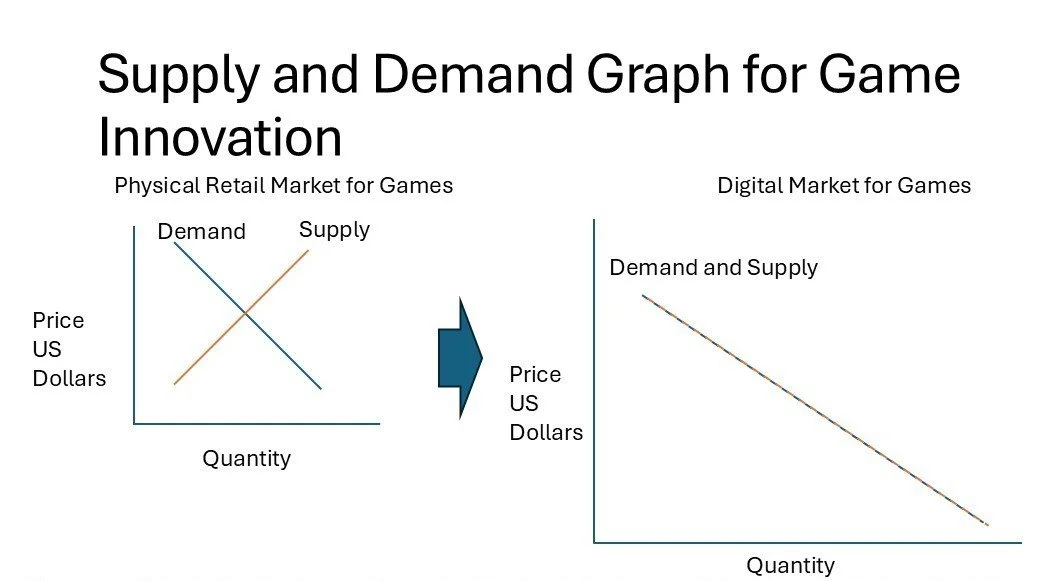
Since supply is digital, the issue of overstocking is relatively nonexistent (no physical copies left over from sales). Digital duplication is nearly free which can increase the supply to meet demand. Digital products can be limited in quantity (like limited digital keys) albeit with some difficulty (copy and pasting a program for distribution), yet the desire of the limited product from individuals who can afford the product will raise the price to meet the market demand price which is in line with the concept of scarcity.
Now with a visual of the market for a nonphysical product, this representation is now closer to the nonphysical medium of an idea since ideas are nonphysical. Now the representation must adjust to the duplication of an idea. This must follow the economic concept of substitution and price elasticity. This is similar to the economic example of a person deciding if they should buy a Coca-Cola or Pepsi to drink. In the realm of an idea, a game idea with no competitors would have a highly inelastic or almost vertical demand and an identical supply curve on a graph. The producer can sell the product at any point with fewer quantities sold at a higher price point. As more copies are sold, the value drops significantly more than the slope of -1 because the curve is almost vertical.
However, as games with similar concepts appear on the market, the market for that similar game product becomes more elastic. The almost vertical slope becomes more horizontal. More substitutes or games that have similar ideas, genres, art, or mechanics will give consumers more variety to choose from with similar outcomes.
For every game with similar art, game mechanics, and system requirements that appears on the market in relation to a target game, the value of the target game decreases per each product per each similarly released game. This is the economic concept of modified innovation.
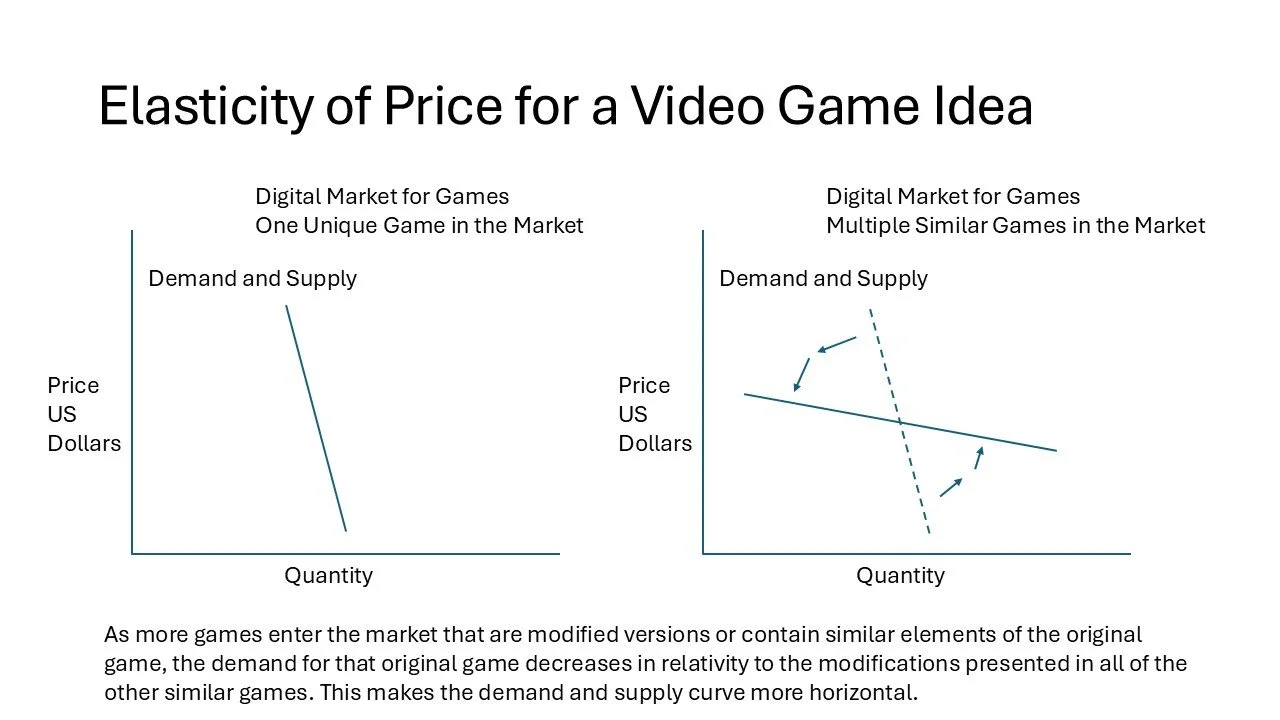
Eventually, an oversaturated market will make the curve horizontal at a fixed price point. We can see this phenomenon in the Apple App Store with apps or games that have nearly identical copies similarly priced at a near consistent $0.99. A large digital brand game that is built based on other digital games with similar and relatable components may not have a large advantage when initially selling smaller quantities at high price points. Small yet very innovative games may have this advantage when initially selling their game. But if a small game runs in a relatable genre recognizable by the consumer base, then the game will sell with little price fluctuation with near or with horizontal elasticity based on quantity sold.
Interestingly, as a market becomes saturated with similar games, a base y-value or fixed price point will occur for that game. This is commonly associated as a retail price of a game set in a digital market. If the game is priced similarly across different hardware platforms and without external market factors like currency conversion and fees, then this would represent the price of the idea in this product or video game.
Factoring in the Concept of Effort
But how does the consumer view the price of a game in terms of effort put into the game? Specifically, without the concept of an interesting idea, are consumers affected by how long and how much work it takes to develop a game? Interestingly, the capital or time required to create the game (employees working on the game) is considered as an abstract idea in of itself from the perspective of the consumer but as a cost for the producer.
A consumer would think that a game priced is based on the quality, manpower (studio size) available, and time developed as a whole product. Not per individual contribution. Thereby measuring the game through its output or final content. A consumer would seldom know how much time each employee contributed to the idea or who created a new idea (like a new game mechanic in the game) in the first place. Valuing quantity of content and brand output are prioritized over time cost and time points directed for the finished product.
In short, a consumer is more interested in buying the content or idea of the game rather than the work behind the game. A reviewer for a game like IGN judges a finished product with a score rather than the process or time milestones of developing the game, and consumers look at the review to make their own judgement on the finished product.
However, a commercially incentivized producer is fundamentally interested in gaining more than the base cost for the work behind the game. Programming, conceptualizing, marketing, and other tasks are viewed by a commercial employer through an individual and time basis under an hourly wage, monthly time contract, or weekly salary payment to an employee. Yet this is in contrast to the idea of what a consumer thinks. A consumer thinks in content output while a producer thinks in time investment in a production which time is equated to monetary costs (time = wages = money). This is the price tag placed on the product by the producer on the game. Therefore, the transaction between a consumer buying a product and a producer selling a product is under the perception that an idea is equal to the materialization effort in monetary terms. Thereby the price of the work is equal to the price of the idea.
Separating the two variables any further would be destructive in both financial terms and logical sense. An idea cannot materialize without any work or effort. An idea needs an action like being spoken, written, or typed to be shared, captured, or sold to others. The same can be said with effort generating an idea or how a random drawing of lines can bring the idea of abstract art. Financially, a separation of the effort of creating a game and a game idea would equate to selling a blank piece of paper or a blank music CD and an internal thought or nothing (materialistically) to a consumer. The market would be stagnant if these two concepts were separated with only an identical medium like blank paper or CDs as a product sold to a consumer. Consumers have no way of knowing how to differentiate between two identical mediums that are devoid of any idea (no brand, logo, pasted on advertisement in contact with the medium).
Therefore, rather than these two definitions being joined by a logical distinction, they are instead joined by a monetary connection (a market exchange medium of money) of two different perceptions (end user product vs effort and time). In this context, the idea (or ideas) within a video game must include the materialization of effort as part of the video game product.
In short, ideas are cheap to think but materialising the idea is expensive. Consumers view the price of an idea while game companies view the price of effort for materialising an idea. Game companies want to reduce the materialisation costs to the same price or less of an idea to make profit or break even. Money or effort connects the idea to reality. If the idea is too expensive to materialize, then the game will likely not be made. If the idea is cheap to materialize, then the game will likely be made.
Very Cheap Free-to-Play Games
Based on the elasticity demand and supply concept, it is theoretically possible that a game will hit the price point of $0 at a large enough price quantity with a slope that is less than 0. A near horizontal demand and supply curve from an oversaturated idea market (lots of other similar games) which the target game has a barely unique idea compared to other similar games would be able to achieve a near infinite amount of quantity bought by consumers before the consumer demand and supply reaches the point of $0. Logically, this falls into line with the thinking that if a game has unique elements, then some people may not get the game due to the unique elements. But if a game has no unique elements (theoretically that is a game that contains all elements from every other single game), then it is very difficult for a person to dislike the game based on the unique elements (unless they dislike all the elements). This is also translated as a game meant for everyone which is desired by everyone.
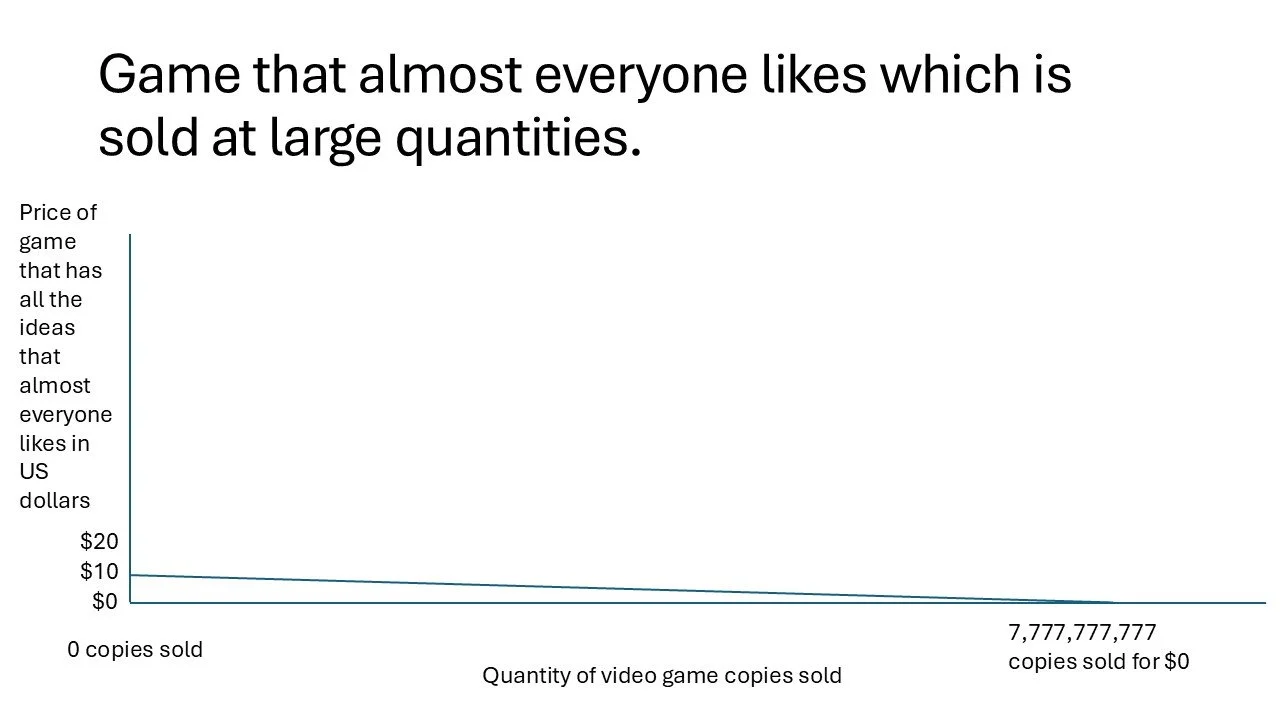
In an ideal scenario, having a game that is priced at a perfectly horizontal $0 slope at the price point of $0 would make the game accessible to everyone financially and would not be constrained by people disliking the game. This would maximize (infinitely) the amount of quantity sold at $0 price point to consumers but decrease the need for new innovation of new ideas in a game because the target game is based off of other similar games. Realistically, a video game company would sell their idea or ideas for $0 at a large quantity, thus maximizing consumer demand and video game supply. This is called a free-to-play game. However, how would this be sustainable to a company that has a large production cost but initially sells their game with a $0 revenue stream?
A free-to-play game with a $0 price tag must make up the cost of development from the consumer within the game. This is done by selling a unique idea (armor, characters, pay-to-win items, etc.) in the game at a fixed price or through a chance price system. This is called content in a game.
Summary
Video game companies innovate to find new ideas to sell to people. They can research a new idea which is expensive compared to partially innovating and building on an already successful idea. Video game companies recuperate development costs to make a new idea by spreading costs among consumers. Getting more consumers who want to buy the game is important. Selling games on a digital platform is beneficial because there is no overstocking or understocking of selling game copies to consumers, so supply will almost certainly equal demand. Therefore, the want or demand to buy the game to cover development costs and the supply of the game being logically dependent on demand makes the video game selling centered around consumer demand. Consumers want to buy an idea or ideas in a video game while video game companies materialize the idea or ideas in a video game. Consumers mainly value the presented and finished idea while game companies value the development of an idea in a video game. This disconnect between consumers and video game companies is mainly tied together by money. Video game ideas are a substitute good with the uniqueness of the idea or ideas in the game determining if the consumer will choose the game over other games. Video game companies can maximize the selling of the game or quantity sold by making the game as similar as possible to other games and then selling the game at $0. This is the starting concept of a free-to-play game.
In the next article, I will explain how companies monetize these ideas as content and why companies choose free-to-play models to sell these ideas as digital products. I will demonstrate the effectiveness of a monetization model in a video game that uses “rolls” or purchasable chances to have a chance to obtain a digital product in comparison to a digital product with a fixed retail price. The question that I will answer is why selling cheap lottery tickets that will give you a popular shirt if you win is more economically effective than selling a popular shirt for a one-time purchase.
Patreon to support the website: patreon.com/ReiCaldombra As a free member you can get notified about new uploads on Blog Under a Log. You can also become a paid member to financially support the website, but any support is greatly appreciated!
Sources:
Nintendo Unveils Game Boy Advance SP
Nintendo Switch: Release Date, Price, Specs (Time Magazine): https://time.com/4632820/nintendo-switch-nx/
Minecraft on PC surpasses 30m sales | GamesIndustry.biz
When Did Minecraft Go Up In Price Over The Years? A Pricing History - ExpertBeacon
Concord Is Estimated to Have Sold Only 25,000 Units. Here’s Why Analysts Think It Failed - IGN
Concord: The game no one wanted - The Rocky Mountain Collegian
Current US Inflation Rates: 2000-2025
Bureau of Labor Statistics Data (set year to 2000-2025 and click “12-Month Percent Change” and “include annual averages”)
Concord’s $39.99 Price ‘Provides the Full Experience’, Sony Says - IGN
New Report Says Sony’s ‘Concord’ Cost $400 Million To Make
Control has sold over 2 million copies - GamesBeat
Which edition of Control should you buy?: Control: pre-order bonuses, deluxe editions, release date and more
Control tops €92 million in revenue, sequel to have budget of €50 million | Game World Observer
Conversions:
2019 59.99 Dollars=59.83 2024 dollars= 57.69 Euros 2024(12/19/2024) = 47.60 Euros in 2019
29.99 dollars 2024=28.92 Euros(12/19/2024)=23.86 Euros in 2019